
What Boundary County Tax Records Contain
Idaho assessment starts with market value. Taxable value is what remains after exemptions. The collection side applies levies and records what is due or paid, while county GIS supplies discovery data only, with no dollar value, exemption, or bill balance.
| Field | What It Shows | Where |
|---|---|---|
| Market and assessed value | Annual value basis before exemptions | Boundary County Assessor |
| Taxable value | Value after qualifying exemptions | Assessment roll |
| Exemption status | Approved property relief or classification | Assessor |
| Bill and installments | Obligation, payments, and balance | Boundary County Treasurer |
| Delinquency trail | Notice, redemption, auction, and deed evidence | Treasurer, commissioners, Recorder |
A sale price is a transaction fact. It is not the assessment or the bill, and Idaho ratio studies compare sales against assessments to test whether values track the market-value standard.
The Boundary County GIS Has No Dollar Value
The parcel layer lists assessed acreage, classification codes, tax-code area, inspection year, owner text, address, and deed references. That is where the numbers end. No dollar value or bill balance appears. Codes lack a legend. Sample tax code 40000 should stay untranslated without county guidance, and valuation questions belong with the Assessor page.
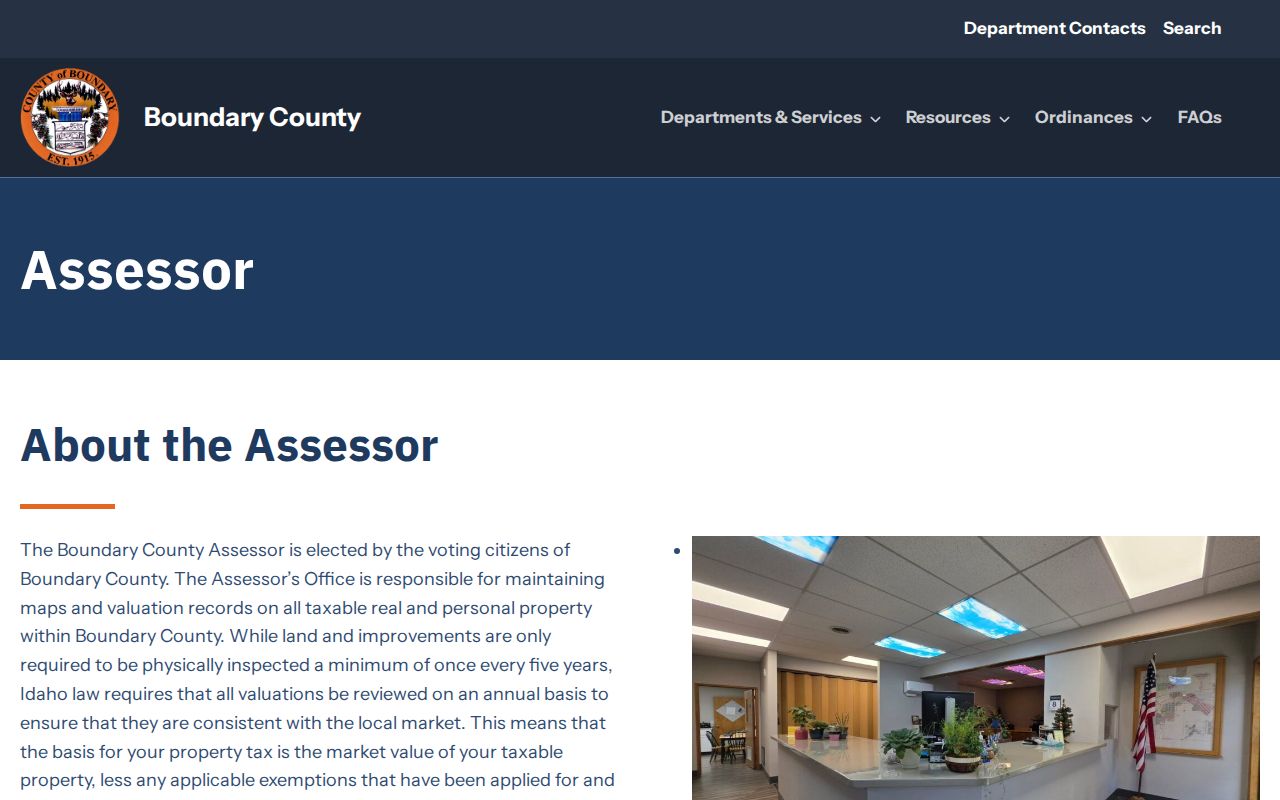
The office page explains the assessment function. It publishes no parcel-specific value-history screen, so use the APN to ask the Assessor for the full assessment record.
Boundary County's Annual Assessment Calendar
The Idaho Assessor's Calendar and county guidance frame the annual cycle. Notices generally arrive in June. Contact the Assessor promptly to inspect the record and its supporting facts. Appeals go to the Board of Equalization. The deadline is the fourth Monday in June. The Assessor physically inspects property at least once every five years while reviewing value annually, so a GIS inspection year proves neither the valuation year nor the date ownership fields changed. New construction has separate fall notice timing.
Note: Use the deadline printed on the current notice and confirm it with the Assessor because the appeal period is short.
Look Up a Boundary County Tax Obligation
The Treasurer page describes collection and payment. It publishes no searchable public tax roll, so locate the exact parcel in GIS first and then ask the Treasurer for current and prior-year status.
- Copy the exact parcel ID and address from the county map.
- Contact the Treasurer for the current bill, installments, payments, and delinquency.
- Compare the tax basis with the Assessor's value and exemption record.
- For delinquency, inspect notice, redemption, auction, and recorded deed evidence.
- Assessed value
- The Assessor's market-value determination before exemptions.
- Levy
- The taxing-district rate applied to taxable value.
- Homeowner exemption
- Qualifying relief that reduces taxable value.
- Tax lien
- The statutory claim associated with unpaid property tax.
Point & Pay Accepts Payments, Not Searches
The county's Point & Pay instructions require tax type, parcel number, amount, and payment details. Credit and debit carry set fees. Credit costs 2.50 percent with a $2 minimum, debit $3.95, and e-check $1.50, with the vendor returning confirmation and a printable receipt.
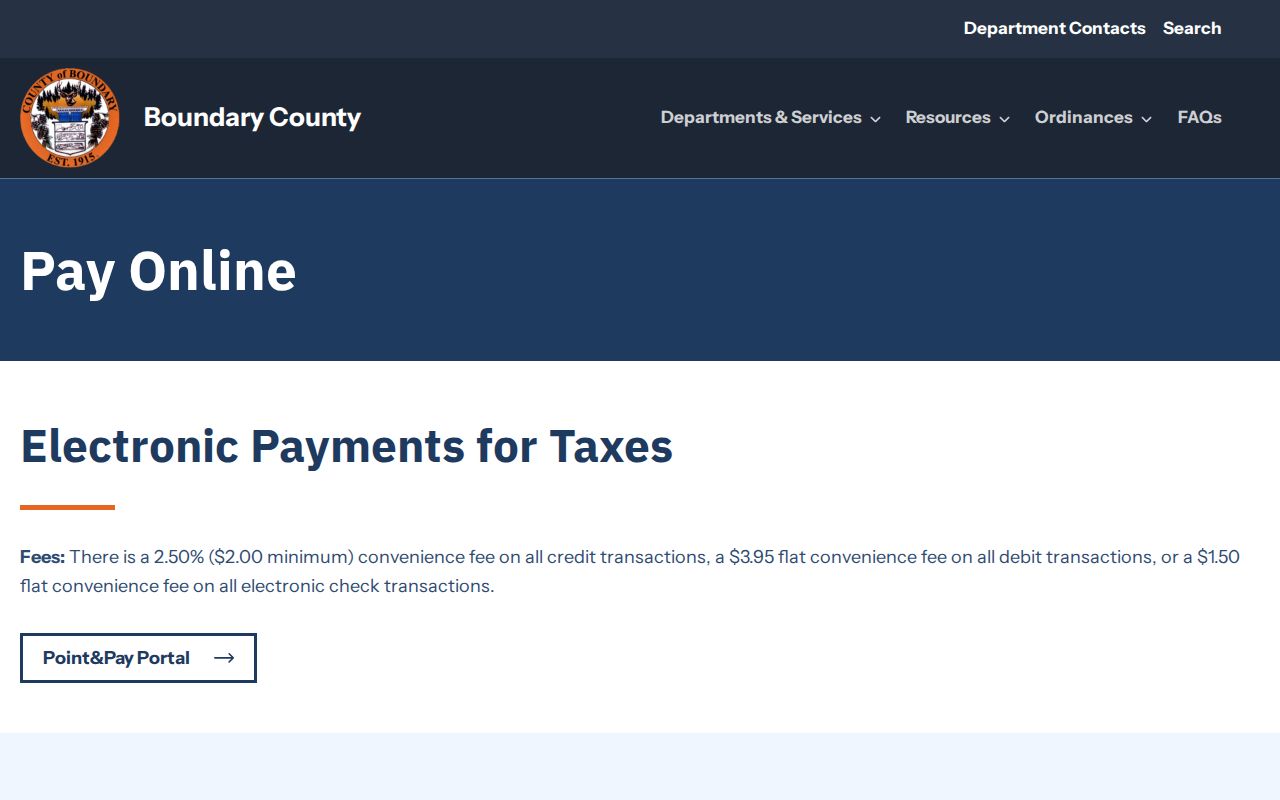
This is a payment channel. It is not a public bill-result page. Verify the parcel and amount with the Treasurer, since partial payments are permitted and a partial receipt does not show a fully paid account.
December and June Divide the Tax Year
The Treasurer sets December 20 as the first-half due date. June 20 closes the second half. Late charges, interest, and delinquency can change the balance. Check office guidance when a date lands on a weekend or legal holiday. Manufactured homes need separate care. Idaho Code §63-304 governs statements of intent affecting real-property treatment, so confirm classification with the Assessor and Treasurer rather than trusting the map's manufactured-home point layer.
Boundary County Tax Deeds Follow a Timeline
Tax deeds here follow a timeline. County materials lay out three-year delinquency, notice and hearing, newspaper publication, redemption, auction, and recording. The 2024 auction notice listed prior-owner and legal-description information. It required a $100 nonrefundable deposit, set a three-business-day certified-funds deadline, and disclaimed warranties. Unpaid tax alone proves no sale. Trace the parcel through notice, redemption, result, commissioners resolution, and Recorder, with instrument 297245 flagged as a recording lead.
Appeal a Boundary County Assessment
Start with the Assessor. Review the description, acreage, classification, improvements, comparable evidence, and exemptions on file. If nothing changes, file a Board of Equalization appeal. The deadline is the fourth Monday in June. The Idaho Tax Commission explains the market-value standard and the county appeal route. A recent sale helps as evidence but controls nothing, and the GIS outline and inspection year set no dollar value.
Appeal window. Boundary County appeals generally must reach the Board of Equalization by the fourth Monday in June; confirm the current notice immediately.
Separate Exemptions From Boundary County Value
The Idaho homeowner exemption reduces taxable value on a qualifying primary residence. It does not rewrite the Assessor's market-value conclusion. The Idaho Tax Commission homeowner exemption guidance explains eligibility and the application framework. Other relief routes exist. Property tax reduction, deferral, and disabled-veteran programs each carry their own rules. Boundary County's Assessor page also posts agricultural, timber, casualty-loss, and exemption forms, so confirm which form fits the property and tax year. A GIS classification code proves nothing about approval. The inspected layer shows no exemption amount either.
Request Missing Boundary County Tax Material
The county's current records-request form works best when the request is specific. List the parcel number, the tax year, the exact record wanted, and the copy format. Ask for one thing at a time. An assessment record, a payment history, or a delinquency notice each deserves its own line. Hearing material and sale records do too. A request for "everything" on an owner slows the response.
Fees follow Resolution 2026-17, which took effect February 2, 2026. The full schedule sits with the Clerk's Office. Under that county resolution, the first 100 pages are free. The Idaho Code provisions it cites set the same rule. Department-specific charges may still apply, so confirm the cost before ordering. Phone, mail, and counter service remain alternatives, since no searchable tax portal exists.
A disputed delinquency calls for the notice date, tax year, principal, and accrued charges. It also calls for the payment posting, redemption status, and hearing material. Include any sale or deed reference. An assessment question is different. For that, request the parcel description, land and improvement detail, and inspection record. Also ask for the classification, exemption action, and Board of Equalization filing information. Keeping the two apart stops a collection problem from masquerading as a valuation problem.
Three Numbers Answer Three Different Questions
| Number | Meaning | Best official source |
|---|---|---|
| Assessed market value | Assessor's annual estimate under Idaho's market-value standard | Boundary County Assessor and assessment notice |
| Taxable value | Value remaining after qualifying exemptions | Assessment roll or notice |
| Sale consideration | Transaction fact reported in a recorded instrument when present | Boundary County Recorder |
None of those three figures equals the annual tax. That number comes from taxable value. It also reflects the levies of the taxing districts that apply. The Idaho ratio-study explanation shows how the state weighs assessed values against sales. It judges assessment level and uniformity. But that countywide test tells you nothing about a parcel's current tax balance.
Comparing a recent sale price with the current assessment takes care. Check the assessment date, the property's condition, and the land included. Also check any exemptions. Ask whether the recorded consideration reflects an open-market deal. A difference does not prove an error. It points to which record and date deserve a closer look next.
Build a Boundary County Assessment Review File
Begin with the notice itself. Write down the tax year and parcel ID. Add the market value, taxable value, classification, and every exemption listed. Then measure the Assessor's acreage against the physical property. Check the improvement description against the county parcel layer too. The layer's acres_assessed field and description fragments can flag a point worth questioning. Category codes and inspection year can too. Unexplained category strings are not proof of any particular valuation treatment.
Build comparable sales around assessment date, property type, location, acreage, improvements, and unusual conditions. Idaho's market-value standard does not force the Assessor to copy a single sale price. The evidence should speak to market value. It must show what the property would command under the applicable valuation framework. Photographs help when they bear on the value issue. So do repair estimates, survey evidence, and recorded restrictions.
Call the Assessor before filing anything. Staff can walk through the record and fix an evident data problem on the spot. Save the notice envelope or delivery record. Keep notes from that conversation. Save copies of submitted evidence and proof the appeal reached the Board of Equalization by the deadline. A clean administrative record pays off if further review becomes necessary.
Distinguish Delinquency From a Completed Tax Sale
These are five distinct stages, not one event. A missed installment, a delinquent account, a tax-deed hearing, an auction notice, and a recorded tax deed each mean something different. Boundary County's 2023 commissioners material referenced parcels delinquent for 2019. The 2024 notice, by contrast, documented an auction process. Confirm that payment or redemption did not occur after the notice, and that a deed was actually issued and recorded.
Search the notice by property number, prior owner, and legal description. Then match the APN in GIS. Ask the Treasurer for the account timeline. Ask the Recorder for the resulting instrument. If excess proceeds entered a separate county or state process, that record alone does not shift the parcel's ownership. Working through the stages in order keeps property from being labeled sold just because it surfaced in a delinquency record.